| Home |
| CV |
| ViperLab |
| Teaching |
| Demos |
| Publications |
| Journal of Problem Solving |

|
Zygmunt Pizlo Now at UC Irvine |
|
|
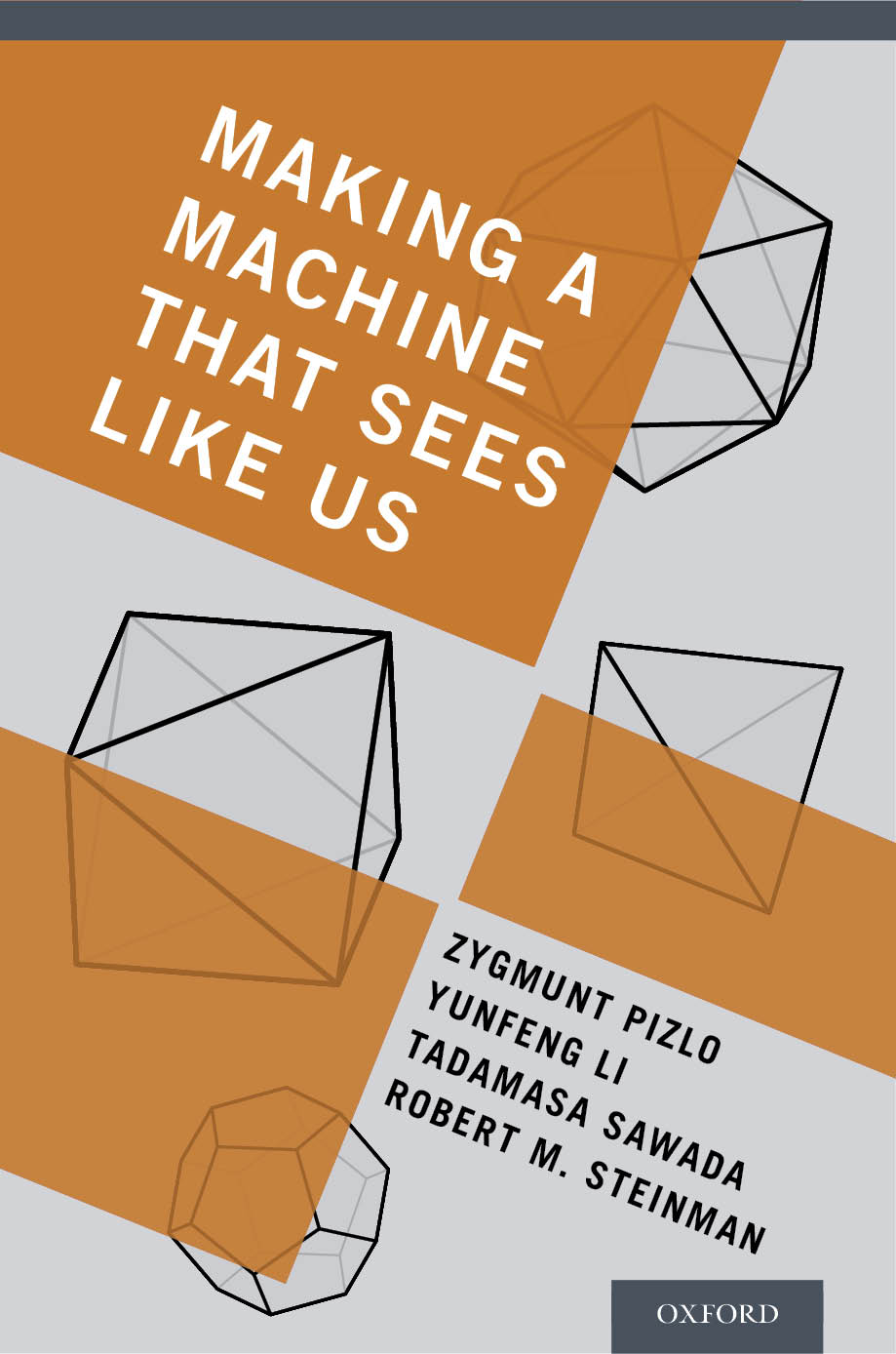
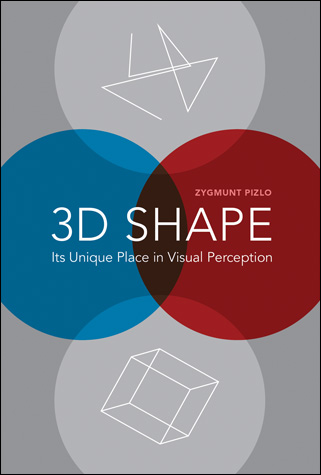
Professor Zyg's Conjecture: veridical 3D vision is mathematically and computationally so difficult that there is only one way to do it. Once you accept this, it follows that all animals (including us) that see the 3D world veridically (or nearly so) use the same algorithm. A computer that can also see veridically, must be using the algorithm that is used by the human visual system. So, there is no longer any need to wonder about whether computer vision should emulate biological vision. It must. Conclusions from the review of "Making a machine...", by Adele Diederich published in the Journal of Mathematical Psychology "What role does symmetry play in the perception of 3D objects?" - see our blog on the Oxford University Press Web site. "Questions about symmetry and visual perception" - tumblr on the Oxford University Press Web site. When Gestaltists stated that "the whole is different from the sum of its parts" they meant that the visual system is not linear. Recall that in a linear system, the response to a linear combination of inputs is a linear combination of the responses to the individual inputs. This is not the case in vision. See the demo (courtesy of Prof. Tadamasa Sawada), which shows that the percept of a 2D hexagon and of a 2D "Y junction" cannot explain the percept of a 3D cube. My work is directed by exploring new ideas rather than following established views. In this approach, rational arguments are as important for me as experimental results. The emphasis on principled reasoning means that in my view, cognitive psychology is not a bag of tricks; Neither is my research. A list of my most important contributions is provided below (in chronological order):1992 - formulated perspective invariants thereby providing the first model-based invariants in vision 1994 - proposed a new theory of shape constancy that is NOT based on "taking slant into account" 1995 - developed a pyramid model explaining the speed-accuracy trade-off in vision 1997 - explained the role of the calibrated camera model in shape perception 1999 - demonstrated shape constancy for solid shapes and explained the apparent controversy between Rock's and Biederman's results 2000 - developed a pyramid model that shows how human beings solve the Traveling Salesman Problem (TSP) 2000 - contributed to the rediscovery of Wertheimer's phi motion 2001 - published a theoretical paper on inverse problems in vision, making it clear that a priori constraints are at least as important as the information in the retinal image 2001 - provided a new criterion for classifying illusions as important or unimportant 2005 - discovered a new binocular phenomenon showing that a priori 3D shape constraints are more important than binocular disparity 2006 - developed a TSP model that emulates human visual attention and eye movements 2008 - published the first coherent treatment of the history of shape perception 2009 - introduced a new theory of 3D shape perception based on symmetry, compactness and planarity constraints 2009 - contributed to the demonstration that the experimental method that uses an adjustable elliptical probe to measure perception of local surface orientation (slant and tilt) is fundamentally flawed 2011 - developed a new Bayesian theory of the veridical binocular perception of symmetrical shapes that emphasizes the role played by stereoacuity 2011 - demonstrated that a priori constraints are more important in achieving reliable shape constancy than depth cues 2011 - published psychophysical results on the transfer of skilled movement that suggested that the motor system has a pyramidal architecture, very much like the architecture of the visual system 2012 - modeled the veridical recovery of 3D scenes and 3D figure-ground organization 2013 - showed that symmetry is the sine qua non of shape 2013 - developed a TSP model with a small human-like working memory 2014 - published a new theory of 3D veridical vision 2014 - contributed to the discovery of new model-based invariants for 3D, piecewise planar, symmetrical curves 2015 - showed that a perceived closed curve is the shortest path in the log-polar representation (aka complex logarithmic map) present in the primary visual cortex (area V1) of primates 2016 - explained how 3D visual perception can be a "hard science" because symmetry, the least-action principle and the conservation laws operate in 3D vision 2016 - helped to explain 3D and 2D figure-ground organization by using 3D symmetry and gravity a priori constraints
These milestones are described in a
little more detail in the Research
link. Links to open access papers are in Publications.
|
| |
 |
|
|
|
|